
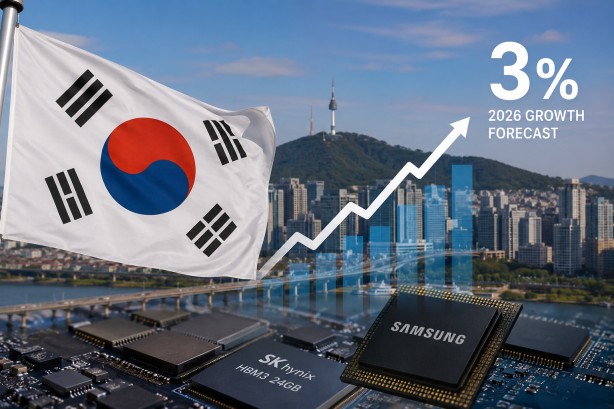
South Korea has revised its economic growth projection for 2026, increasing it from 2% to 3%. This optimistic outlook is largely attributed to robust semiconductor demand and a strong export performance. The government anticipates a 40% surge in exports this year, with the current account surplus expected to hit an unprecedented $290 billion, primarily propelled by the flourishing chip industry.
In an effort to bolster long-term economic expansion, the South Korean government has introduced an ambitious initiative dubbed the “3-4-5 Vision.” This strategy aims to elevate the nation’s potential growth rate to 3%, position South Korea among the globe’s four largest exporters, and boost per capita gross national income to $50,000. A significant aspect of this plan involves substantial investments amounting to 800 trillion won, directed towards enhancing semiconductor manufacturing capabilities.
The investment strategy encompasses major allocations in areas like artificial intelligence infrastructure, advanced chip packaging, and industrial AI applications. While the bulk of these funds are expected to be sourced from the private sector, government support will be crucial in the form of infrastructure development, research, financing opportunities, and regulatory reforms to facilitate these advancements.
Additionally, South Korea is taking steps to attract highly skilled foreign professionals to further strengthen its workforce. Efforts are also underway to bolster supply chain resilience, ensuring stability and efficiency in production and distribution. As part of its forward-looking approach, the government plans to establish a Future Response Fund aimed at investing in next-generation industries, education, and regional development, with the goal of converting the current semiconductor boom into enduring economic growth.