
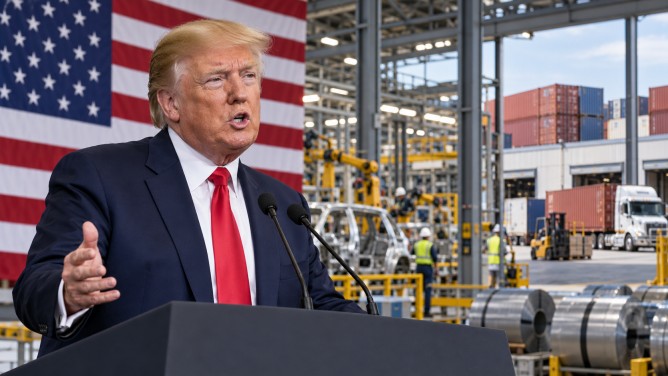
In a push to bolster U.S. manufacturing, President Donald Trump has issued a stern warning to foreign companies: establish factories in the United States or face tariffs ranging from 150% to 300%. Trump has set an 18-month window for these companies to set up manufacturing operations domestically, framing the policy as a strategic move to enhance foreign investment and expand the nation’s manufacturing sector.
This warning coincides with ongoing negotiations between the United States and South Korea, which recently culminated in a $350 billion investment agreement. Under the terms of this deal, South Korea has committed to investing $350 billion in the U.S., a move that will see tariffs on Korean goods reduced from 25% to 15%. The investment package notably includes $150 billion allocated for shipbuilding cooperation and an additional $200 billion for strategic investments.
Despite the agreement, there remain points of contention, particularly concerning South Korea’s involvement in the proposed Alaska LNG project. South Korean officials have expressed the need for a thorough commercial viability review before proceeding with investments in the project, which carries an estimated cost between $44.5 billion and $54.5 billion. The project envisions the construction of a significant pipeline, gas treatment facilities, and an LNG terminal.
The first tangible result of the U.S.-South Korea investment agreement is the confirmation of a new gas-fired power plant in Texas. Discussions are also underway regarding potential collaboration on nuclear reactors, although these plans are still pending further evaluation.