
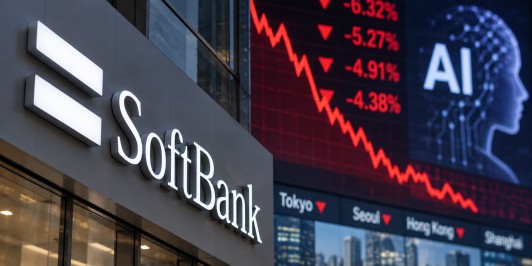
Monday saw a mixed performance in Asian stock markets, with a notable drop in shares of Japan’s SoftBank Group, which plummeted over 10%. The decline in SoftBank shares, specifically a 11.2% fall, was prompted by increasing concerns regarding the rapid advancements in artificial intelligence. Major AI companies have been advocating for enhanced safety protocols and a more measured approach to the development of powerful AI systems. As a significant investor in OpenAI, SoftBank’s stock suffered amid these calls for caution.
The impact of these AI-related apprehensions was felt across Asian technology and semiconductor stocks. In South Korea, SK Hynix saw its shares decrease by 5.3%, and Samsung Electronics experienced a 2.8% drop. Meanwhile, Japan’s Kioxia Holdings and Tokyo Electron also faced downturns. The broader market indices reflected these challenges, with South Korea’s Kospi declining by 2.5% and Japan’s Nikkei 225 falling by 0.8%. In contrast, Hong Kong’s Hang Seng and the Shanghai Composite in China managed to edge slightly higher.
The recent volatility in AI stocks is part of a larger debate regarding the potential for tighter regulation on the development of advanced AI systems. As companies continue to push the boundaries with more autonomous technologies, there is growing investor anxiety over how future regulatory measures might impact the sector. This concern is intertwined with broader market considerations, such as rising oil prices and their implications for inflation and global economic growth.
Oil prices surged by more than 3%, driven by heightened concerns over global energy supplies after attacks targeted Saudi Arabian energy infrastructure. Brent crude oil prices reached approximately $108 per barrel, while US crude surpassed $103 per barrel. This increase in oil prices has contributed to inflationary pressures, adding another layer of uncertainty for investors who are also closely monitoring the US Federal Reserve’s upcoming decision on interest rates.
In the United States, Treasury yields have remained high, with the 10-year yield nearing 5%, reflecting ongoing worries about inflation and rising government debt levels. Despite these challenges, Wall Street closed on a positive note last Friday after several days of losses, as the S&P 500, Dow Jones, and Nasdaq all posted gains. However, market participants remain vigilant, focusing on developments in the Middle East, energy prices, interest rates, and the evolving landscape of AI regulation.